

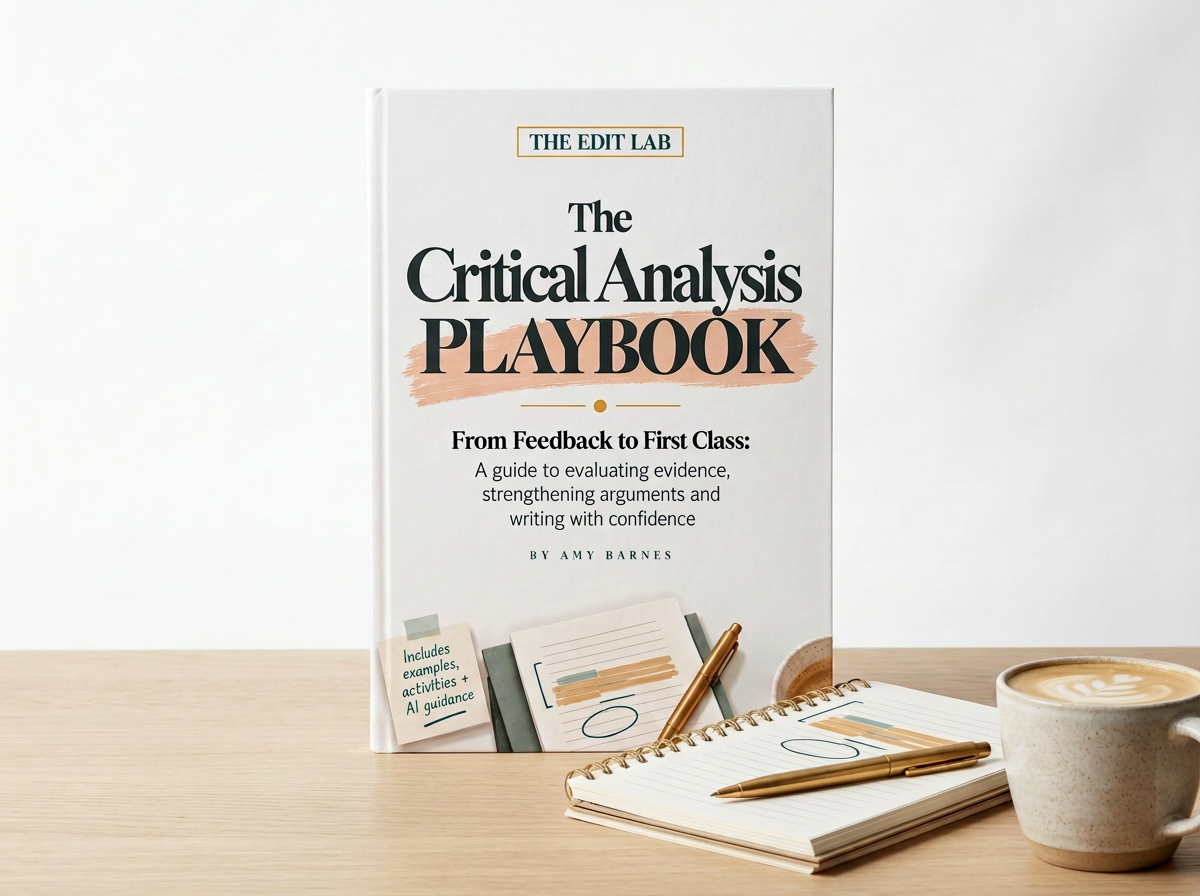
 Image 1 of 3
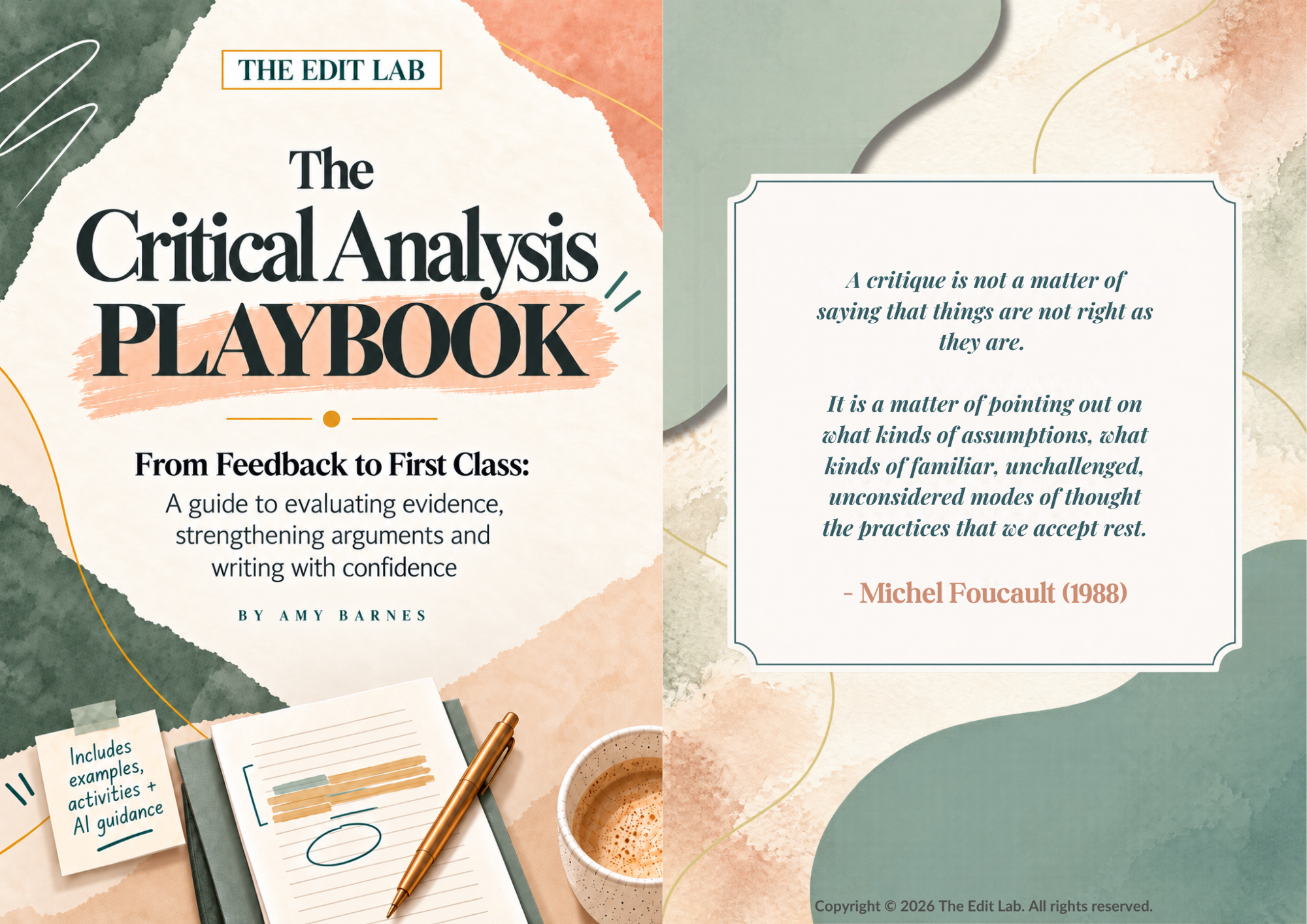 Image 2 of 3
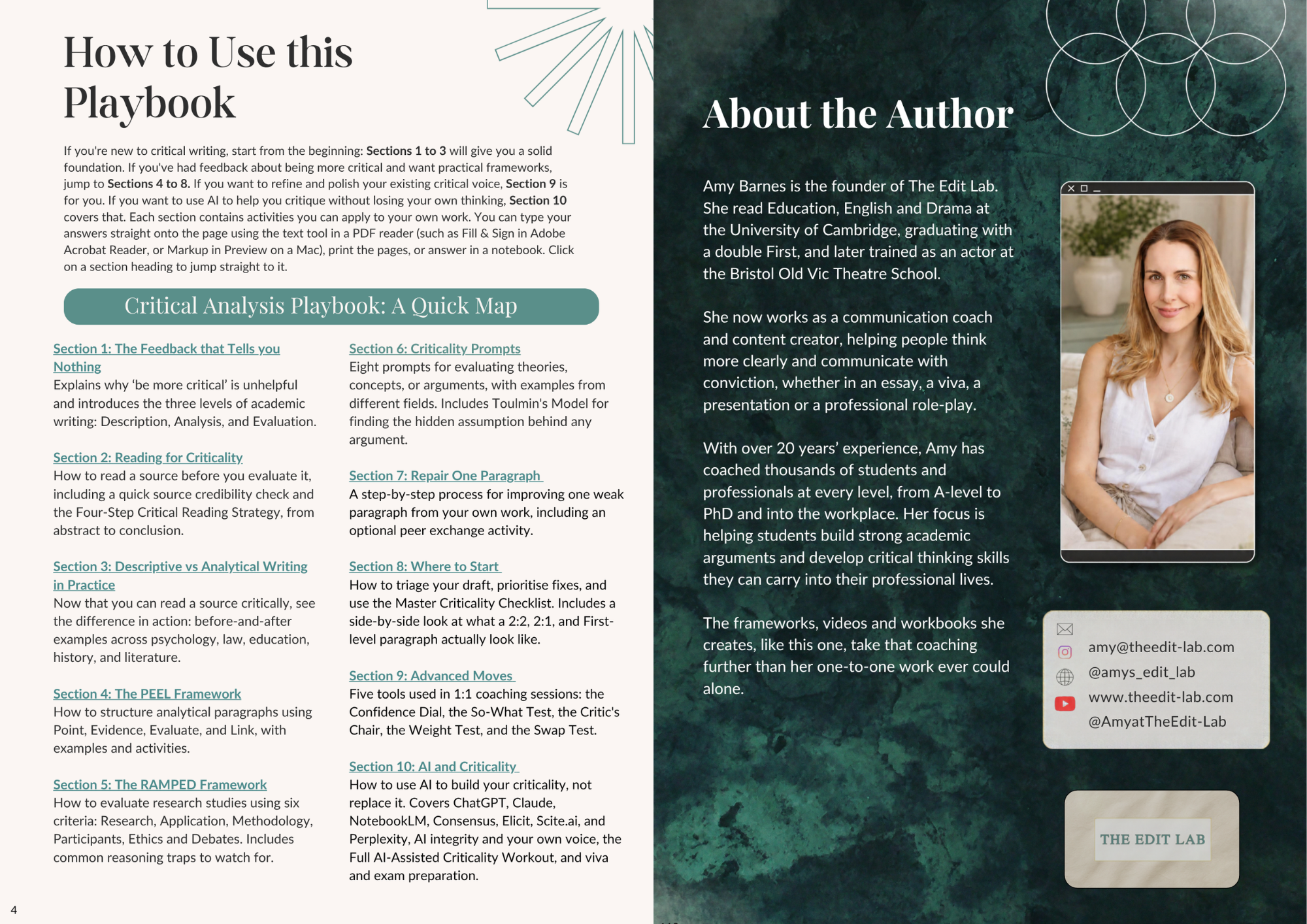 Image 3 of 3
👈 60 seconds on why I made this
After 20 years of coaching students, the feedback I see most is “be more critical”. And almost nobody explains what it means. So I put everything I teach into one playbook.
✓ 110 pages of clear steps, examples and activities
✓ For A-level essays right through to dissertations
✓ Instant PDF download
The Critical Analysis Playbook: From Feedback to First Class
Someone's written "be more critical" on your essay. Again. No explanation, no example, just three words and a vague sense that you've disappointed a stranger with a red pen. (Helpful.)
This playbook is the explanation that should've come with the feedback. It's 110 pages of frameworks, worked examples and activities that show you what criticality looks like on the page, and how to build it into your own writing one paragraph at a time.
I'm Amy, founder of The Edit Lab. I have a double First from Cambridge and over 20 years of coaching thousands of students from A-level to PhD, and I've seen that feedback land on more essays than I can count. This is everything I teach in my 1:1 sessions, in one place.
Inside, you'll find:
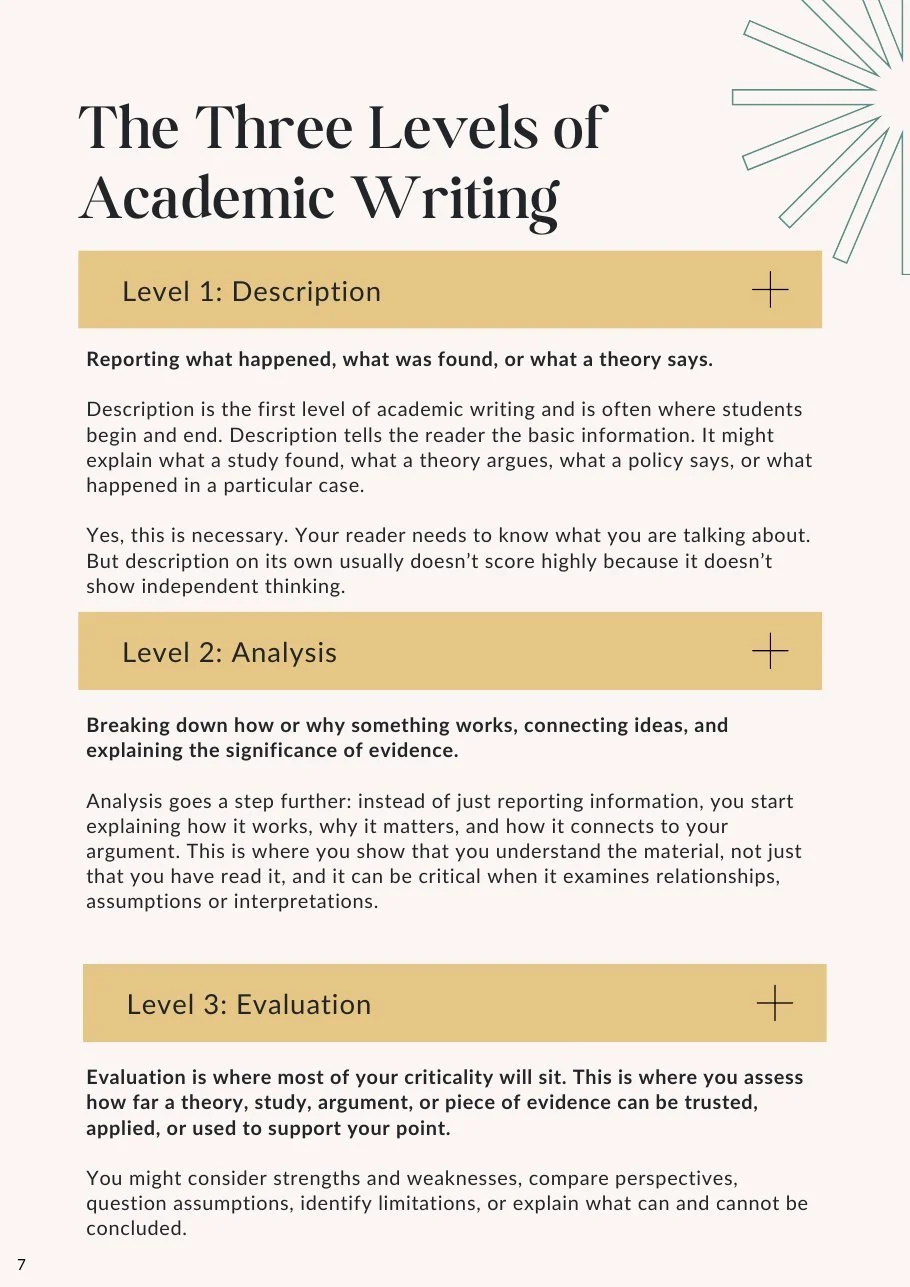
The three levels of academic writing, and how to spot which one you're stuck at
How to read a source critically, from abstract to conclusion (plus a quick check for whether it's worth reading at all)
PEEL, rebuilt so the evaluation finally gets a proper job
RAMPED, my six-angle framework for picking a study apart (politely)
Eight Criticality Prompts for theories and arguments, plus how to find the hidden assumption in any claim
A step-by-step process for repairing one weak paragraph from your own draft
The same point written at 2:2, 2:1 and First level, side by side
Five advanced moves from my coaching sessions: the Confidence Dial, the So-What Test, the Critic's Chair, the Weight Test and the Swap Test
How to use AI to sharpen your thinking without handing it over, with ChatGPT, Claude, NotebookLM, Consensus, Elicit, Scite and Perplexity
Examples across psychology, law, education, history, literature, business and more
Who it's for: A-level and university students who keep being told to be more critical and would quite like someone to explain how. It works for first-year essays right through to dissertations.
What you get: A 110-page PDF, ready to download straight away. Type your answers onto the page in a free PDF reader, print it, or scribble in a notebook (no judgement). A 1:1 session with me is £95. This is the same method I use in those sessions, for a fraction of the cost, and you can read it at 2am in your pyjamas.
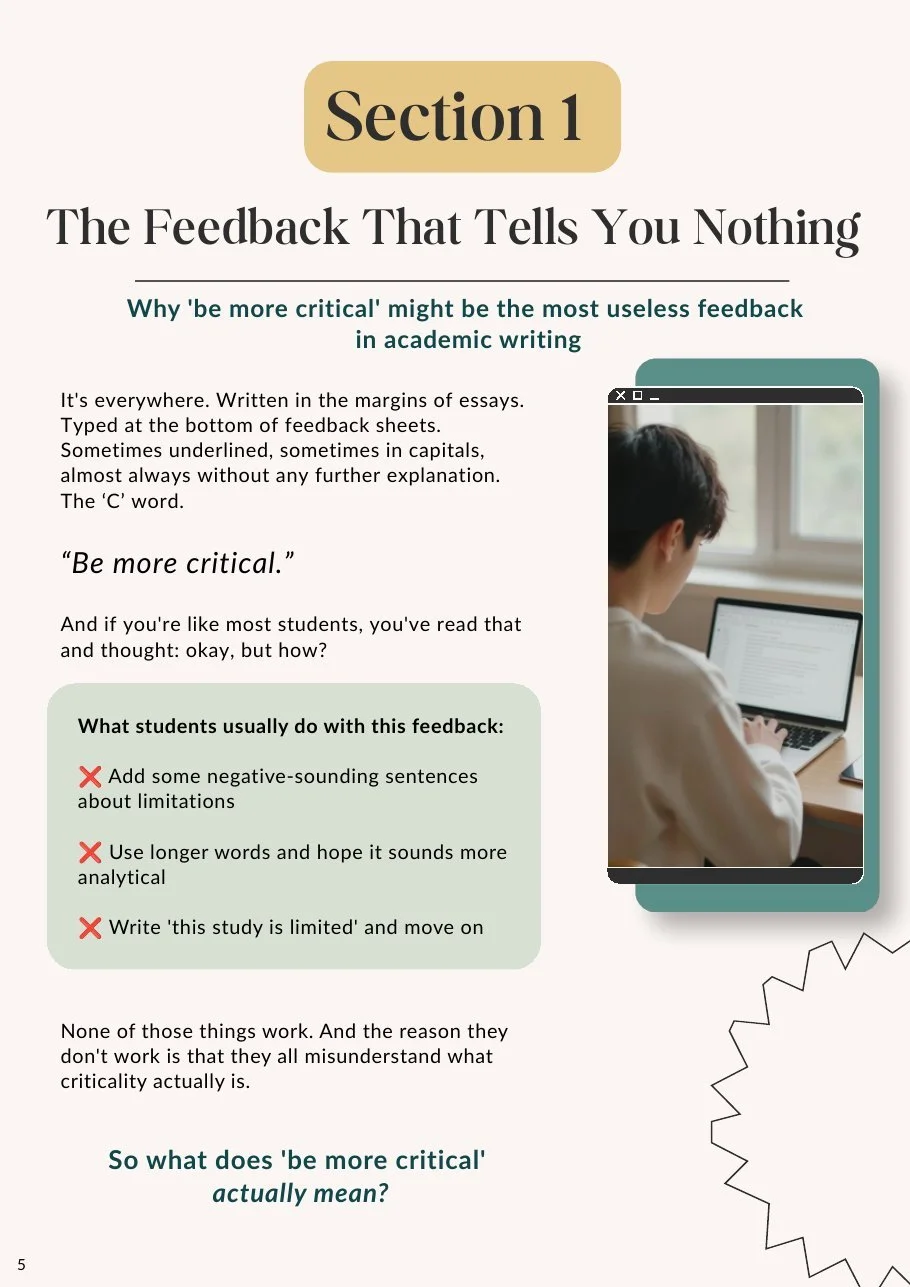
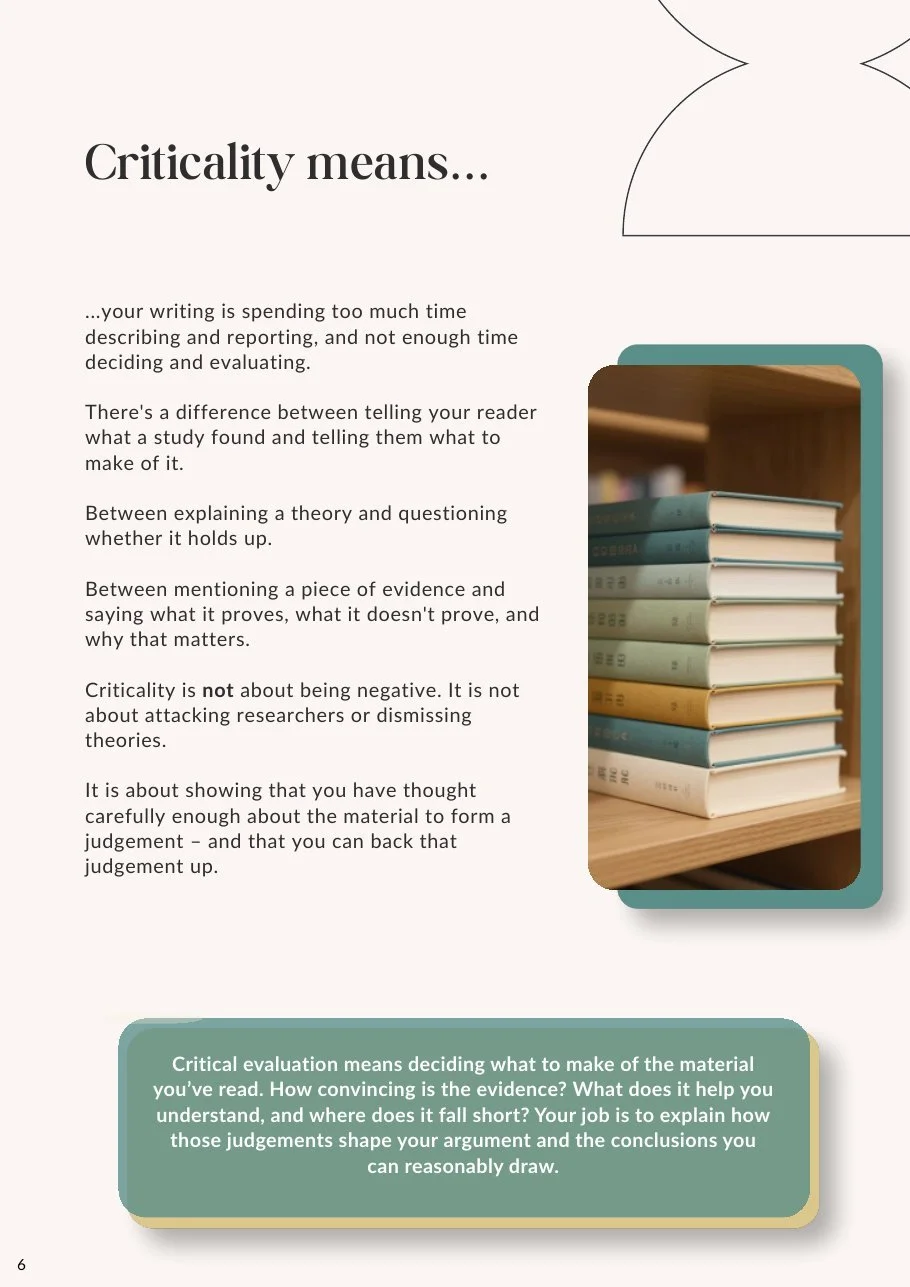
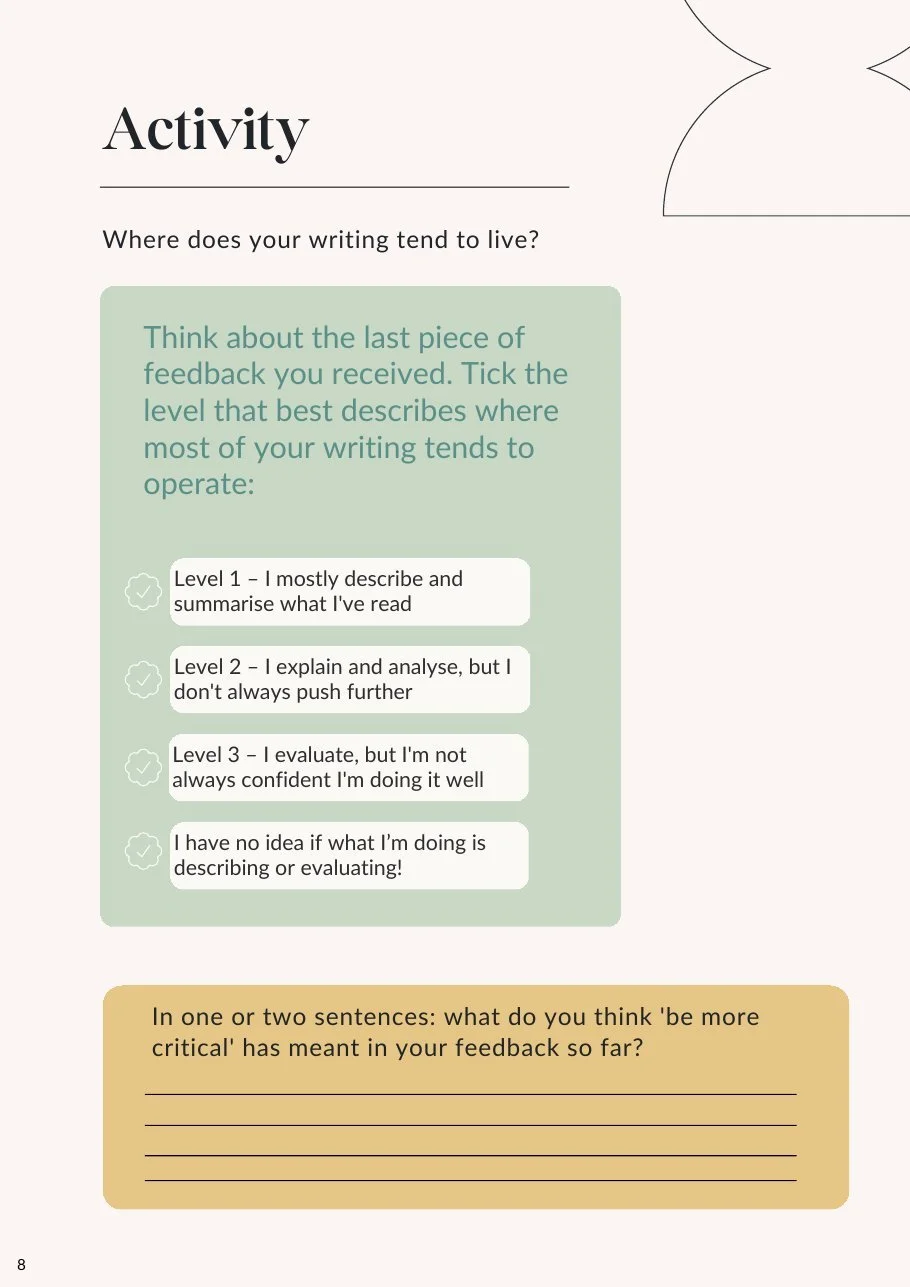
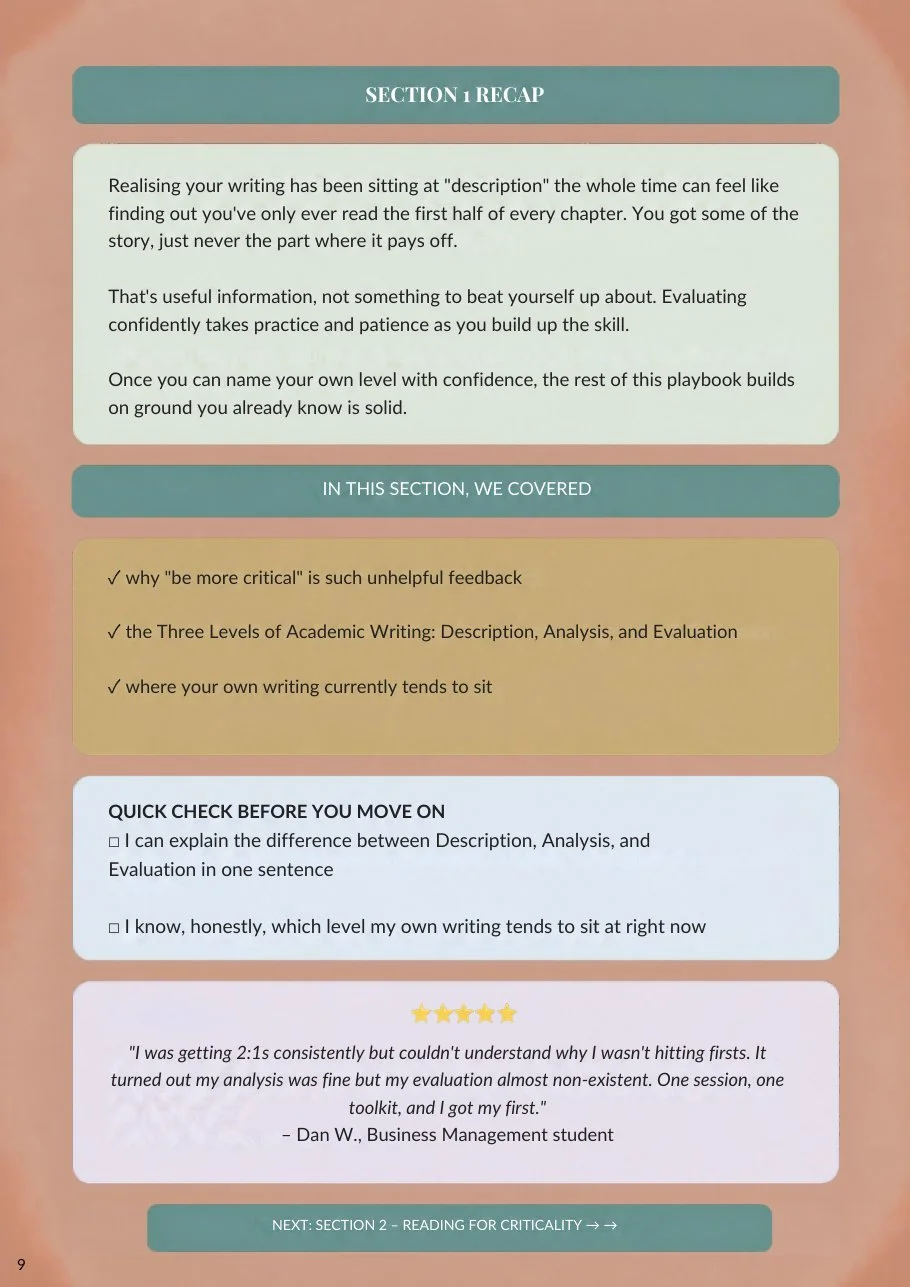
Not sure yet? Read Section 1 free below 👇
Testimonials
"Going through this section helped me realise I had about six solid paragraphs in my essay and six that were just summarising sources. I fixed two of the weakest ones and my grade jumped from a 58 to a 68."
– Tom H., Second-year Sociology student
"I'd been using ChatGPT to rewrite my paragraphs and my grades weren't improving. Once I started using AI to understand rather than to produce, I could feel my analysis getting stronger, and my essays started sounding like me again."
– Rosa F., Second-year Politics student
"I could spot limitations in a study, but struggled to explain why they were important for my essay. The toolkit helped me turn those observations into a clearer argument."
– Gemma P., Postgrad Business Management student
The Critical Analysis Playbook: From Feedback to First Class
Someone's written "be more critical" on your essay. Again. No explanation, no example, just three words and a vague sense that you've disappointed a stranger with a red pen. (Helpful.)
This playbook is the explanation that should've come with the feedback. It's 110 pages of frameworks, worked examples and activities that show you what criticality looks like on the page, and how to build it into your own writing one paragraph at a time.
I'm Amy, founder of The Edit Lab. I have a double First from Cambridge and over 20 years of coaching thousands of students from A-level to PhD, and I've seen that feedback land on more essays than I can count. This is everything I teach in my 1:1 sessions, in one place.
Inside, you'll find:
The three levels of academic writing, and how to spot which one you're stuck at
How to read a source critically, from abstract to conclusion (plus a quick check for whether it's worth reading at all)
PEEL, rebuilt so the evaluation finally gets a proper job
RAMPED, my six-angle framework for picking a study apart (politely)
Eight Criticality Prompts for theories and arguments, plus how to find the hidden assumption in any claim
A step-by-step process for repairing one weak paragraph from your own draft
The same point written at 2:2, 2:1 and First level, side by side
Five advanced moves from my coaching sessions: the Confidence Dial, the So-What Test, the Critic's Chair, the Weight Test and the Swap Test
How to use AI to sharpen your thinking without handing it over, with ChatGPT, Claude, NotebookLM, Consensus, Elicit, Scite and Perplexity
Examples across psychology, law, education, history, literature, business and more
Who it's for: A-level and university students who keep being told to be more critical and would quite like someone to explain how. It works for first-year essays right through to dissertations.
What you get: A 110-page PDF, ready to download straight away. Type your answers onto the page in a free PDF reader, print it, or scribble in a notebook (no judgement). A 1:1 session with me is £95. This is the same method I use in those sessions, for a fraction of the cost, and you can read it at 2am in your pyjamas.

And Before You Ask…
-
It’s written for A-level students up to dissertation and Master’s level. If someone has written “be more critical” on your work, it’s for you, whatever your year.
-
The examples cover psychology, law, education, history, literature, business and more. The frameworks travel well, because criticality looks much the same whether you’re evaluating a study, a case or a novel.
-
A 110-page PDF that downloads straight away. You can type your answers onto the pages (Fill & Sign in Adobe Reader, or Markup in Preview on a Mac), print it, or use a notebook.
-
No. The “How to Use” page sends you to the right place. If you’re new to critical writing, start with Sections 1 to 3. If you’ve had the feedback and want fixes, go to Sections 4 to 8. Section 9 is for polishing, and Section 10 covers AI.
-
Yes. Section 8 shows you what to fix first, and Section 7 walks you through repairing one weak paragraph from your own draft. Tom went from 58 to 68 by fixing two.
-
It shows you how to use AI to question and understand sources, never to write for you. Always check your university’s or school’s AI policy as well.
-
Yes. Read and download Section 1 above!
-
The playbook is the toolkit I use in my 1:1 sessions. Coaching applies it to your own work, live. If you’d like that, book a free call.
-
Because the playbook downloads straight away, I can’t offer refunds once you’ve downloaded it. That’s why Section 1 is free, so you can see if it’s for you first. If your file won’t open or something’s gone wrong with it, email me and I’ll sort it.
The Critical Analysis Playbook: From Feedback to First Class
Someone's written "be more critical" on your essay. Again. No explanation, no example, just three words and a vague sense that you've disappointed a stranger with a red pen. (Helpful.)
This playbook is the explanation that should've come with the feedback. It's 110 pages of frameworks, worked examples and activities that show you what criticality looks like on the page, and how to build it into your own writing one paragraph at a time.
I'm Amy, founder of The Edit Lab. I have a double First from Cambridge and over 20 years of coaching thousands of students from A-level to PhD, and I've seen that feedback land on more essays than I can count. This is everything I teach in my 1:1 sessions, in one place.
Inside, you'll find:
The three levels of academic writing, and how to spot which one you're stuck at
How to read a source critically, from abstract to conclusion (plus a quick check for whether it's worth reading at all)
PEEL, rebuilt so the evaluation finally gets a proper job
RAMPED, my six-angle framework for picking a study apart (politely)
Eight Criticality Prompts for theories and arguments, plus how to find the hidden assumption in any claim
A step-by-step process for repairing one weak paragraph from your own draft
The same point written at 2:2, 2:1 and First level, side by side
Five advanced moves from my coaching sessions: the Confidence Dial, the So-What Test, the Critic's Chair, the Weight Test and the Swap Test
How to use AI to sharpen your thinking without handing it over, with ChatGPT, Claude, NotebookLM, Consensus, Elicit, Scite and Perplexity
Examples across psychology, law, education, history, literature, business and more
Who it's for: A-level and university students who keep being told to be more critical and would quite like someone to explain how. It works for first-year essays right through to dissertations.
What you get: A 110-page PDF, ready to download straight away. Type your answers onto the page in a free PDF reader, print it, or scribble in a notebook (no judgement). A 1:1 session with me is £95. This is the same method I use in those sessions, for a fraction of the cost, and you can read it at 2am in your pyjamas.